




What launching a Renault taught us about the only communications principle that actually works in a saturated market.
We had a car to launch, and it was a really good one. A genuinely well-designed, properly spec’d SUV in a market where every other week another brand is doing exactly the same thing: red velvet rope, a spotlight, polished spec sheets, and applause for a vehicle most of the room will never buy.
The brief was clear and the product was strong. But here was the trap: when the product is good, the instinct is to lead with the product. Put it on a pedestal. Talk about it. Demonstrate it. Make sure everyone in the room knows why it deserves their attention. This feels like the logical move. It is also, almost always, the wrong one.
Displacement. What does it mean?
There is a principle we decided to go with when conceptualising this campaign, and it did not have a widely used name, so we will give it one: displacement. The idea is simple. The more you push an audience toward something, the more they resist it. The more you pull their attention elsewhere and let them walk toward it on their own terms, the more they want it.
Displacement is not misdirection, or some sort of trick. It is a structural decision about what carries the emotional weight in a communications experience, and what simply receives it.
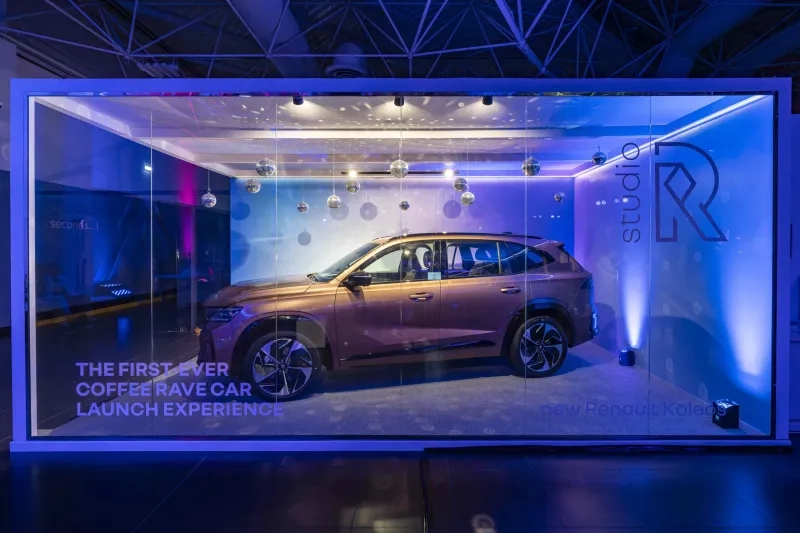
For the Renault Koleos launch, we made a deliberate choice: the car would not be the point of the evening. Coffee would be the point. Music would be the point. The room, the light, the smell, the energy, the people would all be the point. The car would simply be present, waiting, like the best kind of idea, confident enough not to announce itself.
Why coffee and raves are not gimmicks
Each element was chosen because it carried a specific cultural signal that mapped directly onto the brand. Coffee culture in the UAE stands for craft, intentionality, and considered choices. That is exactly the audience Renault needed in the room for a vehicle positioned around design and lifestyle. The coffee was the perfect way to curate the audience.
The rave element, the deep-house, the DJ booth, the after-dark energy, sent a different signal: this brand is not speaking to the generation that bought cars at dealerships on a Tuesday afternoon. This is for people who decide with feeling before they verify with function. The energy in that room told a story about what kind of brand Renault had decided to become.
Nothing was ambient. Nothing was filler. The barista counter, the personalized photo coasters guests took home, the cryptic RSVP countdown on Instagram beforehand, each was a deliberate signal to a specific type of person that this was worth showing up for.
The client loved it so much they asked us to formally establish a new marketing vertical for AWR Automotive Renault built around culture, art, and community. We called it StudioR. A one-night coffee rave where 300 guests came for the culture and walked past a Koleos without ever feeling like they were being sold to. The client had challenged us to pull 100. They would not leave the showroom.
More importantly, this was not just another themed launch event. It was the first coffee rave ever staged inside a car showroom in the UAE, and potentially the first in the region. That mattered because the format itself became part of the story. The novelty was not created through spectacle alone, but through an intentional collision of spaces and cultures people did not expect to coexist: specialty coffee, underground music culture, and automotive retail.
That was not done by accident. This was achieved through strategic thinking.
The brief did not ask for this. We brought it anyway.
Here is what most people misunderstand about creative ambition in a client context: thinking beyond the brief is not the same as ignoring it. The brief set parameters around audience, timing, brand tone, and commercial outcomes. Every single one was met. We just refused to treat the brief as a ceiling.
The question we kept asking was not “what does the brief require?” It was “what does this audience actually respond to?” Research told us that the people we needed to reach, design-conscious, culturally engaged, younger consumers in Dubai, share experiences, not specifications. They do not post a photo of a horsepower figure. They post the room they were standing in when they first encountered something that felt new.
So we built the room first. A specialty coffee bar from Emirati Coffee Co. A DJ set from No Filter DXB. Light corridors, interactive design installations, fashion-inspired photo zones. The Koleos sat at the center of all of it, but it did not compete for attention. It absorbed it.
The lesson, and it is uncomfortable
Displacement as a strategy requires trust. Trust from the client that the product does not need to be the loudest thing in the room to be the most remembered. Trust from the agency that the work is strong enough to let the audience arrive at the conclusion themselves. Trust, on both sides, that restraint is a form of confidence.
Most communications breaks down at exactly this point. The product team wants more features mentioned. The brand team wants more logo exposure. The result is an activation that feels like a sales pitch wearing a costume. Audiences today are extraordinarily good at detecting that costume. The moment a room feels like it was built to sell something, the walls go up. The moment it feels like it was built for them, the walls come down.
StudioR was built for them. The Koleos was simply the most compelling thing in it. 4.01 million video views, 3.2 million reach, and a measurable rise in test-drive bookings, not because we talked about the car more, but because we talked about it less.
That thinking also became the reason the campaign evolved beyond a successful launch into an industry-recognised case study, earning nominations across MEPRA, PRCA, and the MENA Digital Awards. Not because it was loud, but because it challenged a category assumption most automotive launches still operate within: that the car itself has to dominate the experience in order to be remembered.
What we are actually telling clients now
We are not saying ignore your product. We are saying trust it. A product confident enough to step back and let culture do the introduction will consistently outperform one that insists on leading with its own credentials.
The strongest brand experiences we have built share one quality: they make the audience feel something before they know what they are feeling it about. By the time the connection is made, it is already real. The Koleos did not need to introduce itself. By the end of the night, the room had done it for us.
Coffee. Raves. Creativity. None of those words appeared in the original brief. All three delivered its actual objective, which was never to launch a car. It was to make people want one.